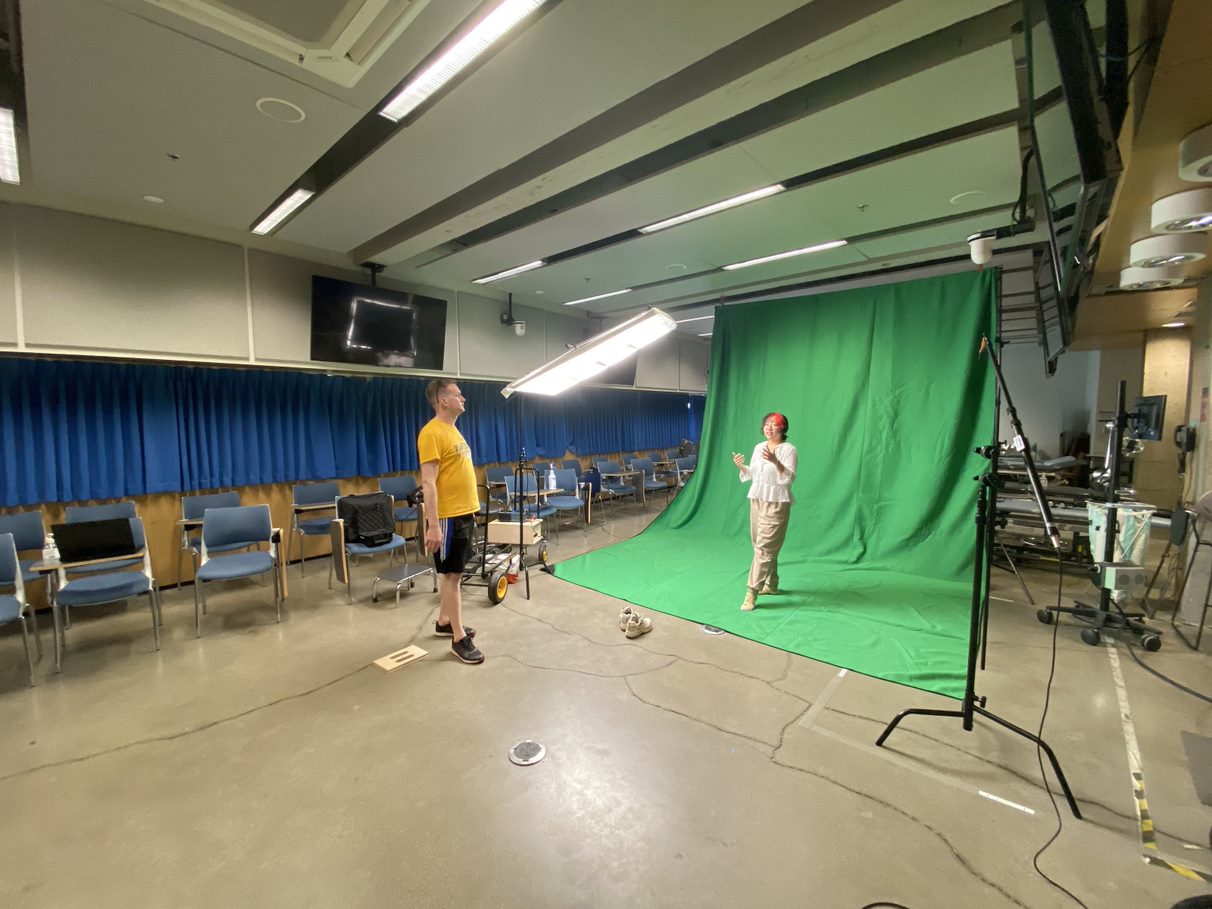
The Immersive Clinical Experience 2 is a case-based simulation learning activity that uses Virtual Reality (VR) to situate Year 1 medical undergraduate students in a realistic clinical scenario. This VR experience gives learners the opportunity to practice interviewing a patient, performing physical exams, ordering diagnostic tests and imaging, and working through their clinical decision-making in an emergency medicine setting. The VR experience allows learners to test their knowledge in a low-stakes yet applied clinical setting.
Building on the positive student feedback heard regarding the first Immersive Clinical Experience, this 2nd case was designed to leverage the affordances of VR for learning:
- Hand-tracking enables greater accessibility for learners to use the technology and gives them the opportunity to use their hands for physical examinations of the patient.
- A voice-activated virtual dictaphone allows learners to rapidly record notable findings to a doctor’s note as they progress through their case.
- High-fidelity 3D environments and realistic soundscapes situate and contextualize learners in clinical spaces, introducing them to these environments before their clerkship years.
- Immediate corrective feedback is provided to learners on their clinical decision-making to support their learning.
- Learning analytics drawn activities within the VR experience serve as both a reflection opportunity for learners and learning insight for teaching faculty.

“It aligned with the curriculum very well and integrated so many different components of our different classes that we take.”
– Year 1 MDUP Learner
The Immersive Clinical Experience 2 was developed with subject matter expertise provided from a UBC Medicine emergency physician and neurology specialists. UBC medical students and residents wrote the initial case and supported scripting for VR. EdTech developed and built the VR experience through extensive iterative feedback processes with learners and instructors.


EdTech operationalized the delivery the VR experience by collaborating with support teams across the BC. Standalone VR headsets were distributed to all 4 primary clinical teaching sites across the province, enabling all Year 1 students equitable access to the same clinical case.
“I felt like it gave me an opportunity to practice and receive feedback on my clinical reasoning, while being in an environment where I could learn without causing harm to patients by not being practiced in my clinical reasoning skills ”
– Year 1 MDUP Learner

Learner feedback from the VR experience was overwhelmingly positive. Learners consistently asked for more VR cases to explore, more VR sessions to participate in, and further incorporation into the curriculum.
Learners expressed an interest in having more chances to be tested in the VR experience and having the freedom to ask their own questions to the patient. Learner feedback will help to inform the future design and use of immersive learning like the VR experience in curricular activities.
Media Highlights